

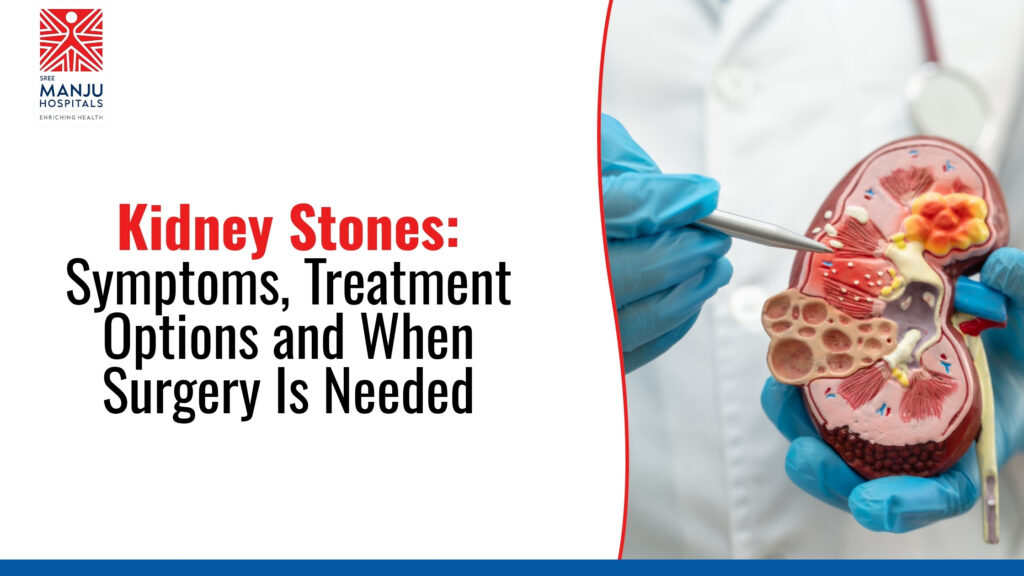
Kidney Stones: Symptoms, Treatment Options and When Surgery Is Needed
A sudden stab of pain in your side that comes in waves. Blood in your urine. A friend who swears by lemon water, another who says surgery is the only real fix. Kidney stones come with a lot of noise, and most of it isn’t accurate.
Here’s the clear version: what kidney stones actually feel like, which ones pass on their own, which ones need a procedure, and how to lower your risk of getting another. Most stones are treatable without a single incision, and knowing your options early makes the whole process far less stressful.
Why kidney stones are so common in India
Kidney stones aren’t rare or unusual. 12% of India’s population is estimated to be prone to renal stone disease, and the country reports roughly two million new cases every year (PMC). Southern states, including Telangana, sit within what researchers call India’s “stone belt,” a band of higher incidence linked to heat, dehydration, and diet.
Hyderabad’s climate plays a direct role. Long hot months mean more fluid loss through sweat, and if water intake doesn’t keep pace, urine becomes concentrated enough for minerals to crystallise. Add a diet with high salt, animal protein, or oxalate-rich foods like spinach and tomatoes, and the risk climbs further.
None of this means a stone is inevitable. It means the causes are well understood, and mostly within your control.
What are the symptoms of a kidney stone?
The classic symptom is sudden, severe pain in the back or side that comes in waves, often spreading toward the lower abdomen or groin. It’s frequently described as one of the sharpest pains a person can experience, and it tends to arrive without warning.
Alongside the pain, watch for:
- Blood in the urine, pink, red, or brown
- A persistent urge to urinate, more often than usual
- Burning sensation while passing urine
- Nausea or vomiting during a pain episode
- Cloudy or foul-smelling urine, which can signal an accompanying infection
- Fever with chills, alongside stone pain, which needs urgent attention
Small stones sometimes cause no symptoms at all and are found only on a scan done for another reason. Larger stones, or ones stuck in the ureter, are the ones that announce themselves.
What happens if a kidney stone goes untreated?
Some stones do need attention sooner rather than later, and it helps to know why. A stone blocking urine flow can cause the kidney to swell, a condition called hydronephrosis, which if prolonged can affect kidney function.
Recurrence is the other part of the picture worth knowing. Once you’ve had one stone, the chances of another rise over time: roughly 10% within a year, climbing toward 50% within a decade (PMC). This is exactly why the diagnosis matters as much as the treatment. Knowing the type of stone you formed shapes the prevention plan that keeps the next one from happening.
The reassuring part: with the right evaluation, most people bring their recurrence risk down substantially.
When should you see a doctor for a kidney stone?
See a doctor immediately if pain is severe, if you have fever with chills, or if you’re unable to urinate. These combinations can signal an infected, obstructed kidney, which is a same-day emergency, not a wait-and-see situation.
For milder symptoms, book a consultation if:
- Pain persists beyond a day or two
- You notice blood in the urine
- You’ve had a stone before and recognise the pain returning
- Burning or frequency during urination doesn’t settle in 48 hours
How are kidney stones diagnosed?
Diagnosis usually takes one visit. A urine test checks for blood, infection, and crystal patterns. An ultrasound is typically the first imaging step, fast, radiation-free, and good at spotting most stones. A CT scan may follow if the ultrasound is inconclusive or if precise stone size and location are needed to plan treatment. Blood tests round out the picture, checking kidney function and calcium levels.
What are the treatment options for kidney stones?
Treatment depends almost entirely on stone size and location, not on how much pain it’s causing:
- Watchful waiting with hydration. Stones under 5mm pass on their own in the majority of cases, usually within four to six weeks, helped along with fluids and pain relief.
- Medical expulsive therapy. Specific medications relax the ureter’s muscle wall, helping slightly larger stones pass more easily and with less pain.
- Shock wave lithotripsy (ESWL). Sound waves delivered from outside the body break the stone into fragments small enough to pass naturally. No cuts, no anaesthesia in most cases, and patients typically go home the same day.
- Ureteroscopy. A thin scope passed through the natural urinary tract reaches the stone directly and removes it or breaks it with a laser. Also usually a same-day procedure.
- Percutaneous nephrolithotomy (PCNL). Reserved for large or complex stones, this involves a small access point in the back to remove the stone directly. It’s more involved than the options above but still far less invasive than open surgery, which is now rarely needed.
Roughly 94% of all kidney stones eventually pass without any surgical intervention when they’re small enough and managed correctly from the start (ResearchGate). Surgery is the exception, not the rule, and it’s reserved for stones that are too large, too stubborn, or blocking the kidney.
Can kidney stones be prevented?
Prevention is largely about consistent daily habits rather than one dramatic change:
- Drink enough water to keep urine pale yellow, roughly 2.5 to 3 litres a day in Hyderabad’s climate
- Cut back on salt, since high sodium pushes more calcium into the urine
- Limit oxalate-heavy foods like spinach, beetroot, and nuts if you’ve had calcium oxalate stones before
- Moderate animal protein, which increases uric acid and calcium excretion
- Get stone composition tested after a first episode, since prevention advice differs by stone type
A ten-minute conversation with a urologist after your first stone can meaningfully lower the odds of ever going through this again.
If pain, blood in urine, or a return of familiar symptoms brings you to this point, the urology team at Sree Manju Hospitals evaluates and treats kidney stones across all three Hyderabad branches, KPHB, Moti Nagar, and Kondapur, with ultrasound, CT imaging, and both ESWL and ureteroscopy available in-house. Cashless insurance is accepted across major providers.
Get it checked before it gets worse
Kidney stone pain rarely announces itself politely, and waiting it out at home is where most people lose time they didn’t need to lose. If you recognise any of the symptoms above, a same-week consultation is the fastest route to relief and a real prevention plan.
Book a urology consultation at your nearest Sree Manju Hospitals branch. Call +91 77779 32772, or walk in at KPHB, Moti Nagar, or Kondapur. A scan, a clear answer, and a plan that fits your stone, not a generic one.