

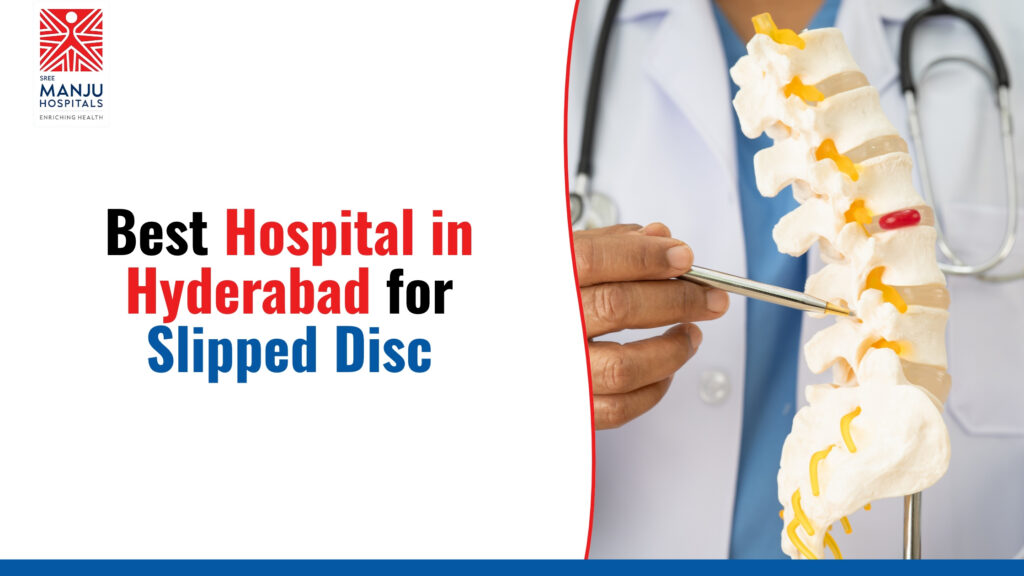
Best Hospital in Hyderabad for Slipped Disc
Back pain that shoots down one leg. Numbness in your toes. Pain that gets worse every time you sit at your desk or sneeze. When an MRI report then says “disc herniation”, the first worry is usually surgery.
Here is the reassuring part: most people with a slipped disc get better without an operation. Germany’s Institute for Quality and Efficiency in Health Care (IQWiG) reports that about 90 in 100 people with back pain from a slipped disc improve within six weeks. So the best hospital in Hyderabad for slipped disc treatment is one that gets non-surgical care right, and can still operate quickly when a nerve is at risk.
This guide explains what a slipped disc is, when surgery is needed, the warning signs to act on, how to judge a hospital, and how treatment progresses week by week.
Key takeaways
|
What is a slipped disc?
A slipped disc, also called a herniated or prolapsed disc, happens when the soft centre of a spinal disc pushes out through a crack in its tougher outer layer. Nothing literally slips. The bulge can press on a nearby nerve and cause pain, numbness or weakness in the leg (sciatica) or the arm, depending on whether it is in the lower back or the neck.
Common symptoms
- Lower back pain spreading to the buttock and down one leg
- Neck pain travelling to the shoulder and arm
- Tingling or numbness in the leg, foot, arm or fingers
- Pain that gets worse when you sit, cough, sneeze or bend forward
- Weakness, such as difficulty lifting the front of the foot or gripping things
Does a slipped disc always need surgery?
No. Most slipped discs settle with time, physiotherapy and pain relief, because the body often reabsorbs the bulging disc material. Surgery is considered when there are signs of nerve damage, such as worsening weakness or loss of bladder control, or when severe leg pain does not improve after about six to twelve weeks of proper non-surgical treatment.
The best evidence supports this approach. A 2023 review in the BMJ, covering 24 randomised trials, found that surgery gave quicker relief from leg pain than non-surgical care, but the benefits faded within 12 months. The risk of side effects was similar either way. “Solving this puzzle of why patients have different outcomes is the key to helping people with sciatica,” said senior author Professor Christine Lin of the University of Sydney.
An MRI report alone is not a reason to operate either. According to IQWiG, around 30 in 100 people aged 20 to 30, and about 40 in 100 people over 50, have a herniated disc on MRI without any symptoms. Treatment should follow your symptoms and examination, not just the scan.
Warning signs that need emergency care
Go to an emergency department straight away if back pain comes with any of these (NI Direct, UK public health service):
These can mean severe pressure on the nerves at the base of the spine. They need an urgent MRI and often surgery within hours, so don’t wait for an OPD appointment. |
How to choose the best hospital for slipped disc treatment
The best hospital for a slipped disc has spine-trained surgeons, in-house physiotherapy, pain management, quick imaging and 24/7 emergency care, and starts with non-surgical treatment unless there is a clear reason to operate. Use this checklist when you compare hospitals in Hyderabad:
| What to check | Why it matters | Question to ask |
|---|---|---|
| Neurosurgeons and orthopaedic spine surgeons | Both treat disc problems; access to both gives a balanced opinion | Who will assess me, and will they explain both surgical and non-surgical options? |
| In-house physiotherapy | Physiotherapy is the main treatment for most slipped discs | Can I start physiotherapy here in the first week? |
| Pain management | Nerve root blocks and epidural injections can control severe pain and help many people avoid surgery | Do you offer spinal injections if pain stays severe? |
| Quick imaging | An MRI shows where the disc is pressing when symptoms are severe or not improving | How soon can I get an MRI if the doctor needs one? |
| 24/7 emergency care | Red-flag symptoms can start at night or on a weekend | Is a spine surgeon on call for emergencies? |
| Conservative-first approach | A good team tells you when you don’t need surgery | What happens if I don’t have surgery? |
| Clear costs and insurance help | Spine procedures are often insured; cashless approval saves stress | Can you give an itemised estimate and handle cashless approval? |
How slipped disc treatment works, step by step
| Stage | Treatment | Typical timing |
|---|---|---|
| 1. Early relief | Pain medicines, staying gently active, avoiding heavy lifting | First 2 weeks |
| 2. Rehabilitation | Physiotherapy to strengthen core and back muscles; posture and desk set-up | Weeks 2 to 6 |
| 3. Targeted pain relief | Nerve root block or epidural injection if leg pain stays severe | Weeks 6 to 12 |
| 4. Surgery | Microdiscectomy or another disc procedure to remove the part pressing on the nerve | After about 12 weeks without improvement, or immediately for red flags |
Many people never go past stage 2. Some move faster through the stages because their pain or weakness is severe from the start. After a microdiscectomy, most people walk the same or next day, return to desk work in two to four weeks, and wait six to eight weeks before heavy physical work.
Slipped disc care at Sree Manju Hospitals
Sree Manju Hospitals treats slipped discs across its three Hyderabad branches:
- Neurosurgery at the Kondapur branch, for spine surgery when it is needed
- Orthopaedics at Kondapur, KPHB and Moti Nagar, to assess back and neck pain
- Pain management at Kondapur
- Physiotherapy for core strengthening, posture correction and return-to-work plans
- 24/7 emergency care at every branch, for red-flag symptoms
If you aren’t sure whether your symptoms point to a disc problem, our guide to signs that need a neuro evaluation can help you decide.
Common mistakes that slow recovery
- Staying in bed for days. Gentle movement speeds recovery; long bed rest stiffens the back.
- Stopping exercises once the pain eases. Core work prevents the next flare-up.
- Choosing surgery because of the MRI alone. The scan has to match your symptoms.
- Ignoring the desk set-up. Hours in a poor chair undo physiotherapy. See our tips on posture mistakes that cause back and neck pain.
- Waiting out red-flag symptoms. Bladder problems or spreading numbness need emergency care, not a wait-and-see approach.
Frequently asked questions
1. Can a slipped disc heal completely?
Yes, in most cases. The bulging part of the disc often shrinks over weeks to months, and symptoms settle. Some people keep mild stiffness or occasional flare-ups, which regular core exercise and good posture help control.
2. Should I see a neurosurgeon or an orthopaedic doctor for a slipped disc?
Both treat slipped discs. For back or leg pain without weakness, either is a good first step. If you have weakness, numbness or bladder changes, a neurosurgeon should see you quickly. Good hospitals plan care jointly with physiotherapy and pain management.
3. Is walking good for a slipped disc?
Yes. Gentle walking keeps the spine moving, improves blood flow to the disc and reduces stiffness. Start with 10 to 15 minutes and build up. If walking clearly worsens leg pain or numbness, stop and see a doctor.
4. Is slipped disc surgery covered by health insurance?
Most health insurance plans in India cover slipped disc surgery when it is medically needed. Some policies have a waiting period for spine procedures, so check your policy terms. The hospital’s insurance desk can confirm cover and arrange cashless approval before admission.
5. Is a slipped disc the same as sciatica?
No. Sciatica is the pain that runs from the lower back down the leg along the sciatic nerve. A slipped disc is the most common cause of it, but sciatica can also come from narrowing of the spinal canal, a tight muscle in the buttock or, rarely, other conditions. Finding the cause decides the treatment.
6. What is the best sleeping position for a slipped disc?
Sleeping on your side with a pillow between your knees keeps the spine straight and takes pressure off the disc. If you sleep on your back, place a pillow under your knees. Avoid sleeping on your stomach, and choose a medium-firm mattress that doesn’t sag.
7. Can I do yoga or go to the gym with a slipped disc?
Yes, once the worst pain settles and with guidance. Avoid deep forward bends, heavy deadlifts, twisting under load and sit-ups in the early weeks. Gentle core exercises, walking, swimming and physiotherapist-approved yoga poses are safer ways to rebuild strength.
8. Does wearing a lumbar belt help a slipped disc?
A lumbar belt can give support and comfort for a few days during a painful flare-up or a long journey. Wearing it all day for weeks weakens the back and core muscles that protect the spine, so use it only for short periods and focus on strengthening exercises.
9. Can a slipped disc happen again after recovery?
Yes. A disc can slip again at the same level or at another one, both after natural recovery and after surgery. Keeping your core strong, maintaining a healthy weight, lifting with your knees bent and taking breaks from long sitting lower the chance of it coming back.
A slipped disc rarely needs to be rushed into surgery, but it does need the right plan from the start. If back or neck pain is spreading to your arm or leg, book a spine consultation at Sree Manju Hospitals in Kondapur, KPHB or Moti Nagar, or call +91 90101 52772.